The story of Elizabeth Freeman is a powerful tale of a woman who was enslaved who challenged the meaning of the Massachusetts Constitution. Her actions helped lead to the freedom of those enslaved in Massachusetts.
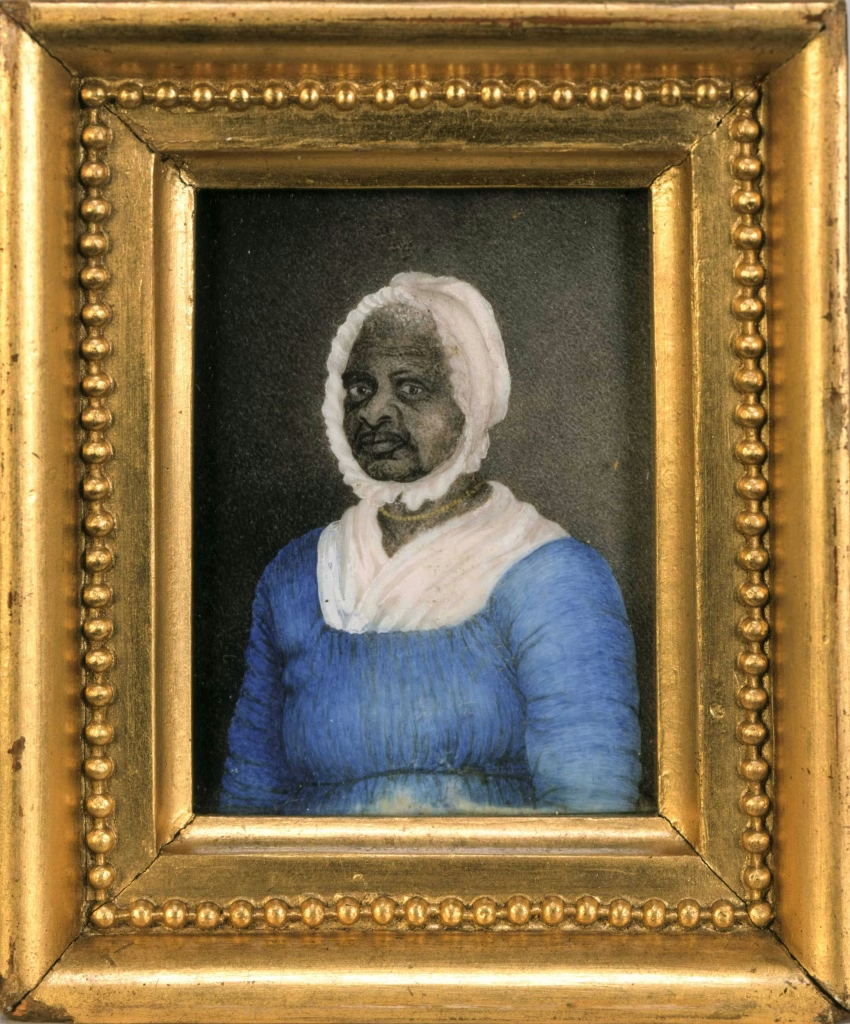
Elizabeth “Mumbet” Freeman
Susan Anne Livingston Ridley Sedgwick (1811 Watercolor)
Born enslaved to Pieter Hogenboom in Columbia County, New York as Mum Bett, Elizabeth Freeman was later enslaved in Massachusetts by Colonel John Ashley in the 1770s [1]. Ashley, a prominent member of Massachusetts society, was a judge at the Berkshire Court of Common Pleas [2]. In 1773, Ashley became the “moderator” of a group that would later pen the Sheffield Declaration, a document that condemned the treatment of Massachusetts colonists by Great Britain and espoused early ideas of equality and the right to life, liberty, and property [2]. Stories about Freeman often involve her listening in at Ashley’s dinner parties, where he would discuss “principles of liberty and equality” with his guests [3]. Freeman is said to have been inspired by these discussions to carry out these tenets as they applied to her own life as an enslaved person. Additionally, an incident where Ashley’s wife tried to hit Freeman’s sister with a hot shovel may have played a large role in her decision to seek freedom. While attempting to shield her sister from harm, Freeman herself was struck by the shovel—it was around that time she decided to flee the Ashley household [2].
In 1781, Freeman decided to take legal action in her fight for freedom from enslavement. She sought the help of Theodore Sedgwick, an abolitionist and lawyer who lived in Stockbridge, Massachusetts [4]. They based her case for freedom on the newly ratified Massachusetts Constitution [3]. Sedgwick argued her case (alongside another enslaved person named Brom, also enslaved by Ashley) on the grounds that “due to the Massachusetts Constitution’s language on equality, slavery was outlawed in the state and Mum Bett and Brom were not Ashley’s legitimate property” [3]. Even after Sedgwick obtained a writ from the court obligating Ashley to free both Freeman and Brom, Ashley refused to comply. The case then went to the County Court of Common Pleas of Great Barrington, where the jury eventually found that both Freeman and Brom were considered free and awarded them 30 shillings each [3]. Soon after this case, another series of cases served to finally abolish slavery in the Commonwealth of Massachusetts. These cases, spanning from 1781-1783 and collectively known as the “Quock Walker” case, resulted in a ruling by [4] the Massachusetts Supreme Judicial Court that slavery was “wholly incompatible and repugnant” to the Massachusetts state constitution [1].
Following the verdict in Freeman’s case, she changed her name from Mum Bett to Elizabeth Freeman, a name representing her new status.
Bibliography
[1] Kerri Lee Alexander. “Elizabeth Freeman.” Accessed January 19, 2026. https://www.womenshistory.org/education-resources/biographies/elizabeth-freeman
[2] Massachusetts Court System. “The Mum Bett Case.” Accessed January 19, 2026. https://www.mass.gov/guides/massachusetts-constitution-and-the-abolition-of-slavery#-the-mum-bett-case-
[3] Alexandra “Mac” Taylor. “Elizabeth Freeman, her case for freedom, and the Massachusetts Constitution.” Accessed January 19, 2026. https://constitutioncenter.org/blog/elizabeth-freeman-her-case-for-freedom-and-the-massachusetts-constitution
[4] Katie Woods. “Elizabeth Freeman (“Mum Bett”) (C.1744-1828).” Accessed January 19, 2026. https://www.mawomenshistory.org/resources/biographies/elizabeth-freeman-mum-bett-c1744-1828
