by Arlene Chen
Known as a prominent advocate in the movements for women’s rights and for abolition, Lucretia Mott was an influential figure who spent her formative years in the Hudson Valley. Mott attended the Nine Partners School, a Quaker School in Millbrook associated with the Nine Partners Meeting starting from the age of 13. Nine Partners School was the first co-educational boarding school in the country, which meant that Mott was exposed at an early age to an environment to which few other girls her age had access. After becoming a full-time teacher at the school, Mott realized that female teachers were only receiving half of what their male counterparts were being paid [1]. In addition, Mott met and was influenced by abolitionist and Nine Partners School Committee member Elias Hicks, who believed that a person’s “Inward Light” was the foundation of Quakerism and whose beliefs led to the creation of a new branch called Hicksite Quakerism. These experiences were important early influences in Mott’s becoming a leader in the fight for abolition and women’s rights. Mott and her husband James, who was also a teacher at the school, were deeply inspired by Hicks and his belief that consumers should boycott sugar, produce, cotton, and other goods that were produced as a result of slave labor [2]. An examination of Mott’s abolitionist beliefs and actions reveals much about the antislavery movement from the perspective of a highly educated Quaker woman.
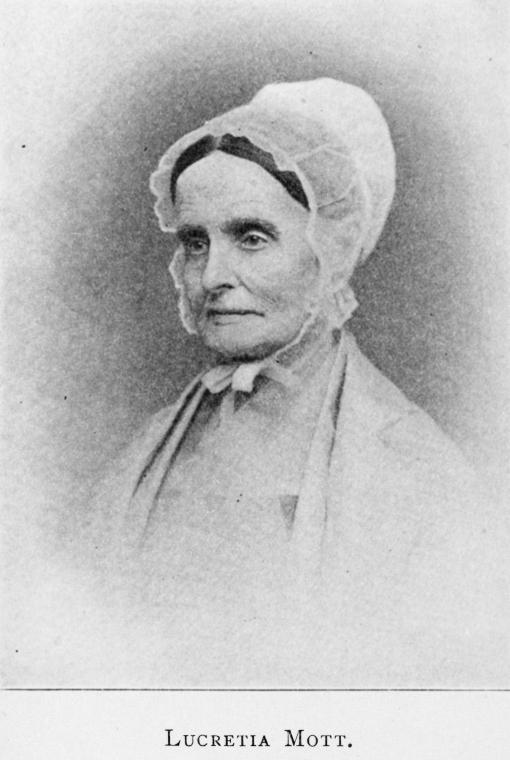
Post-Nine Partners, the Motts went to help a relative with their cotton business [1]. This quickly changed, as the Motts ultimately decided to step away from the cotton industry, which they deemed too closely intertwined with slave labor. Thus began their official participation in the Free Produce Movement. Lucretia Mott was an especially avid supporter of the Movement, adhering strictly to the idea that consuming any goods related to or supporting the institution of slavery was an immoral act. In protest against cane sugar made from slave labor, Mott would pass out maple sugar candies with messages such as “‘If slavery comes by color, which God gave, fashion may change, and you become a slave,’ and ‘Take this, my friend, you need not fear to eat’” [3]. Mott saw engagement in the Free Produce Movement as an act of moral purity in support of antislavery tenets [3]. Her determination to engage heavily with and enact broad social change through these individual boycotts was a testament to the ways in which she broke out of traditional restrictions on women’s ways of thought. Though her actions were that of one individual, they represented the beginning of a larger movement in which she and other women worked strategically to make their voices heard.
Mott’s experience of the inequality of men and women teachers along with the impact of her exposure to and activism in the abolition movement contributed to the development of her ideology and practice that ultimately connected her fight for abolition with the movement for women’s rights. She was a co-founder of the Philadelphia Female Anti-Slavery Society in 1833 and played an important role in planning the 1837 Anti-Slavery Convention of American Women [1]. In 1840, Mott led the women’s delegation to the World Anti-Slavery Conference held in London. The women from the American Anti-Slavery Society were not allowed participation because of their gender. This offense was a factor in bringing together Mott and several notable women’s rights advocates (among them, abolitionists Elizabeth Cady Stanton, Jane Hunt, and Mary Ann M’Clintock) to organize and plan the 1848 Seneca Falls Convention. This new women’s rights movement was heavily influenced by their previous experiences with the antislavery movement [4]. The overlapping involvement of many women in both the antislavery and women’s rights movements is a testament to these women’s courage to fight in ways that defied existing societal expectations. Lucretia Mott was a leader in both movements nationally. Her activism and passion for human rights and justice was strongly influenced by her time as a student and teacher at the Nine Partners School in eastern Dutchess County.
Bibliography
[1] Quakers in the World. “Lucretia Mott.” Accessed February 24, 2025. https://www.quakersintheworld.org/quakers-in-action/63/Lucretia-Mott
[2] Hicks, Elias. A collection of extemporaneous discourses, delivered by Elias Hicks, in his tour through Dutchess County, during the summer of 1829. Taken in short hand by Henry P. Hoag, stenographer. New York: Printed for the proprietor, by H.R. Piercy, 1830. https://www.carpelibrumbooks.com/elias-hicks-quaker-schismatic-who-inspired-lucretia-mott-and-walt-whitman.
[3] Blackmore, Willy. “The Boycott’s Abolitionist Roots: How a group of 19th-century Quakers cut their economic ties to slavery.” The Nation, August 14, 2019. https://www.thenation.com/article/archive/boycott-sugar-slavery-bds/.
[4] National Park Service. “The Underground Railroad and the First Women’s Rights Convention.” Accessed March 3, 2025. https://www.nps.gov/wori/learn/historyculture/the-underground-railroad-and-the-first-womens-rights-convention.htm.
