
by Arlene Chen
Combing through newspapers from the late 1700s and early 1800s reveals many ads from enslavers searching for runaway slaves, but not many responses from those who self-emancipated. This case, researched by Sue Gardner, Local History Librarian and Town of Warwick Historian, reveals an exception to the imbalance in historical perspectives that we find ourselves faced with as historians and learners in the present day. On March 7, 1797, a self-emancipated man named Platt wrote a lengthy letter in the Goshen Repository [1]. His letter was a direct response to a runaway ad published by the Goshen Repository on February 14 of the same year by Roger Clark, Platt’s former enslaver. While runaway ads were common, Platt’s public response was a rare occurrence. In addition, the publication of this response by a local newspaper was a notable move by the publisher. Today, his story serves as an opportunity to learn about the ways in which formerly enslaved people argued for their own rights and exercised personal agency against the brutal system of slavery. It also suggests the need for a deeper conversation on the complicated journey that led to abolition in New York State.
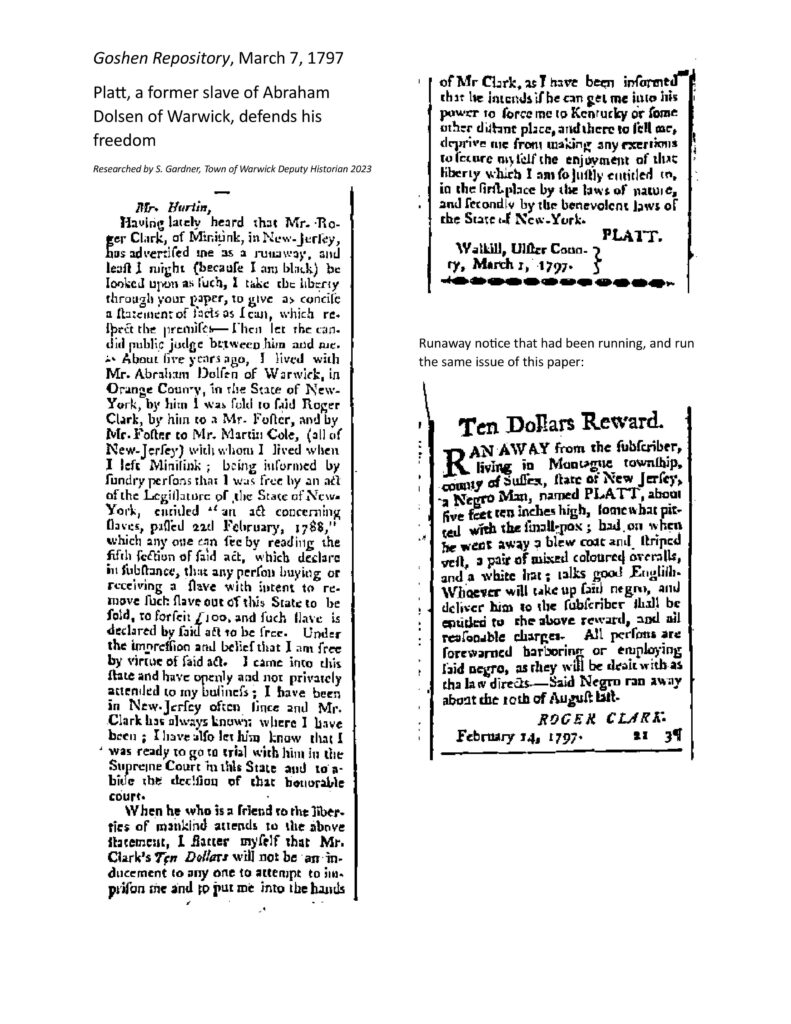
Platt’s letter was at its core an appeal to the public to make a judgment for his case as a free man. In his letter, he stated that he was well aware of the posted advertisement and “might (because I am black) be looked upon as” a runaway [1]. However, Platt, citing “an act concerning slaves, passed 22d February 1788” in New York State argued that because he was sold out-of-state, he was legally a free man [1] [2]. Platt had a solid understanding of his legal rights. He stated that he had been in previous communication with Roger Clark, letting Clark know that he was ready at any time to go to the New York Supreme Court and fight for his rights through trial if needed. In addition, he also appealed to basic notions of rights and liberties, arguing that he was “Justly entitled” to liberties granted by the laws of nature and by the laws of New York State [1]. Platt’s argument had ample legal basis, showed knowledge of the rights he was afforded, and displayed the courage needed to appeal publicly against his former enslaver.
Platt’s story brings life to the voices of many who were silenced by the institution of slavery. The letter he submitted to the Goshen Repository is an example of the agency that many enslaved and self-emancipated individuals exhibited in the fight for freedom and abolition in New York State. Platt’s case is especially significant as a direct response to his enslaver. Sue Gardner points out that at the time of his letter, New York had not yet passed the Gradual Emancipation Law (1799) [3]. Even so, Platt was able to leverage an existing law to make a compelling, legally sound argument for his own freedom. His case illustrates a successful attempt by a formerly enslaved person to defend their individual rights through legal means even before New York’s abolition law became effective in 1827.
Bibliography
[1] Platt. “Letter to the Editor.” Goshen Repository, March 7, 1797. https://albertwisner-montage.auto-graphics.com/#/item-details/entities_25977-A.
[2] New York State Archives. “Laws of 1788, Chapter 40. An Act prohibiting the importation of slaves into New York State.” 1788. https://digitalcollections.archives.nysed.gov/index.php/Detail/objects/49827.
[3] Gardner, Sue. “Platt defends his freedom: Warwick. How a former enslaved man used the power of the press to voice his rights.” Warwick Advertiser, February 5, 2024. https://www.warwickadvertiser.com/opinion/columns/platt-defends-his-freedom-HJ3128768.
Click here for the full text of Platt’s letter.
